Pages

Showing posts with label YOGA. Show all posts

Monday, December 5, 2016

YOGA FOR KIDS


Yoga (meaning union) is the practice of accessing and integrating all aspects of our true nature -- body, mind, and spirit -- in the pursuit of inner harmony. As yoga becomes more popular in schools through physical education classes and after-school programs, that popularity comes with controversy. Although many adults like the benefits of yoga, some parents feel that the practice might have a religious association and, like prayer, shouldn't be allowed in a public space. They argue that yoga is an offshoot of Hinduism and that it disseminates religious and meditation principles with its use of "om" and "namaste" chanting. Some also believe that the asanas, or postures, such as the sun salutation, are a form of Hindu religious worship. To dispel this notion and avoid any religious or cultural messages, most yoga teachers focus on the benefits of the exercises and use generic terms, instead of the Sanskrit names, for the poses, renaming them cat, bridge, table, tree, downward-facing dog, volcano, and so forth. Yoga's rising popularity can be attributed to its basic stretching advantages and improved body awareness, with the added component of a mind-body connection.


Our children live in a hurry-up world of busy parents, school pressures, incessant lessons, video games, malls, and competitive sports. We usually don’t think of these influences as stressful for our kids, but often they are. The bustling pace of our children’s lives can have a profound effect on their innate joy—and usually not for the better.
I have found that yoga can help counter these pressures. When children learn techniques for self-health, relaxation, and inner fulfillment, they can navigate life’s challenges with a little more ease. Yoga at an early age encourages self-esteem and body awareness with a physical activity that’s noncompetitive. Fostering cooperation and compassion—instead of opposition—is a great gift to give our children.
Children derive enormous benefits from yoga. Physically, it enhances their flexibility, strength, coordination, and body awareness. In addition, their concentration and sense of calmness and relaxation improves. Doing yoga, children exercise, play, connect more deeply with the inner self, and develop an intimate relationship with the natural world that surrounds them. Yoga brings that marvelous inner light that all children have to the surface.
Shana Meyerson, the founder of mini yogis, believes that yoga builds self-esteem and self-respect. "A child's yoga practice is a rare opportunity to experience play and focus without worrying about being wrong," she says. Meyerson believes that yoga is an option for children who shy away from physical activity or group activities for fear of failure or being picked last, and it helps athletic children excel in other physical activities and sports. 
There are five key areas where kids benefit from the practice of yoga, and each of them improves their overall well-being.
It Enhances Physical Flexibility
 Yoga promotes physical strength because kids learn to use all of their muscles in new ways. Whether a pose is done standing, sitting, or lying down, each one can challenge various muscle groups while helping a child become aware of his body and how it efficiently functions.

It Refines Balance and Coordination

 Balance is a key element of yoga. Balancing poses were created to promote mental and physical poise, as mental clarity and stability emerge from the effort of trying the poses.
It Boosts Self-Esteem and Confidence 

Yoga helps to instill confidence and to bring learning to children on an experiential level,"It helps to provide building blocks for the future. It is our responsibility to develop our children's sense of wonder and to give them a strong sense of self so they know where they belong in this world and can contribute to making their community a better place." Yoga teaches them to persevere, be patient, and work toward their goals.
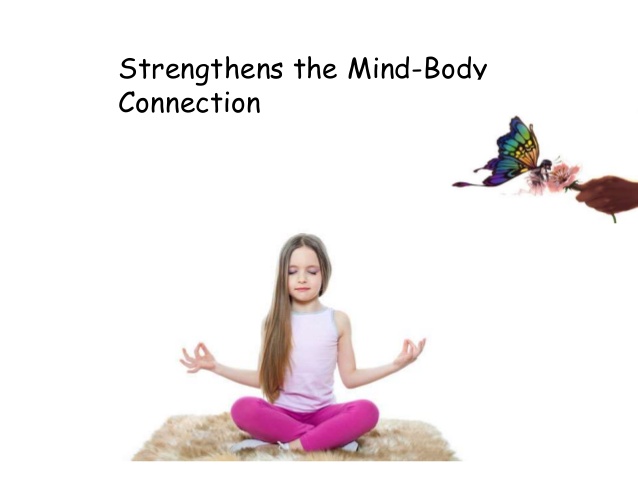
It Strengthens the Mind-Body Connection

 Yoga helps kids achieve a sound mind in a sound body by exercising the physical body and calming the mental spirit. "As parents we want our children to act and behave with mindfulness and with compassion, to be brave, to know love and happiness, and to find inner peace," De Collibus says. "Since the modern world moves very, very fast for children, it's not long before they feel all kinds of pressure (personal, parental, social) to keep up with everyone around them. Yoga functions as a release valve that alleviates pressure and as a foundation to nurture and develop a resilient and resourceful body, mind, and spirit."
Yoga is beneficial to children of all ages, but it has been found to be particularly so for kids with special needs. Studies have shown that yoga benefits children with autism and ADHD. NPR has reported that researchers surveyed teachers at a Bronx public school that had a daily yoga program and found that the program reduced kids' aggressive behavior, social withdrawal, and hyperactivity, compared with a control group of kids with autism who did not practice yoga. Kristie Patten Koenig, Ph.D., an associate professor of occupational therapy at New York University who led the study, says that yoga was effective because it seemed to play to the strengths of kids with autism while also reducing stress. Autism Key, an autism support website, says that yoga helps address kids' heightened anxiety, poor motor coordination, and weak self-regulation, something that otherwise is very difficult to do.

Sunday, December 4, 2016

CHAIR YOGA POSES FOR SENIORS OR PERSON UNABLE TO SEAT ON THE FLOOR


Yoga offers many benefits, from reduced stress to improved strength and flexibility. But it can also be intimidating to some people. You might feel that you just "don't bend that way" or might not be able to keep up with others in a class, or have physical limitations that prevent you from easily moving up from and down to the floor or standing for a full hour. Chair yoga is a gentle style of yoga you can do from a seated position that also incorporates the breathing and mind-body benefits of a traditional class.
Chair yoga is a general term for practices that modify yoga poses so that they can be done while seated in a chair. These modifications make yoga accessible to people who cannot stand or lack the mobility to move easily from standing to seated to supine positions. Many of the basic body mechanics of the individual postures are retained, no matter the stance of the practitioner. While seated on chairs, students can do versions of twists, hip stretches, forward bends, and mild backbends.In addition to a good stretch, chair yoga participants can also enjoy other health benefits of yoga, including improved muscle tone, better breathing habits, reduction of stress, better sleep, and a sense of well-being.

Who Can Do Chair Yoga?

Chair yoga is mostly for senior citizens, obese people and people with neurological diseases. 

What's In a Chair?

Since chair yoga is all about adaptability, it should come as no surprise that the particular chair you use is not important; you don't have to run out and buy a specialized yoga chair. Chairs with wheels are not ideal since they are unstable, but almost any other chair will do. If you are short, put blocks or a folded yoga mat under your feet to give yourself a firm foundation.

CHAIR YOGA ASANAS (POSES)

1. Seated Mountain (Tadasana)


This is a great pose to simply engage your core, check in with your posture, and focus on your breath. Come to this pose after each of the poses below.
  1. Take a deep breath and sit up straight, extending your spine.
  2. As you exhale, root down into the chair with your sitz bones (the lowest part of your tailbone, or the two points that take the weight when you sit).
  3. Your legs should be at 90-degree angles, knees directly over your ankles. You want to have a little room between your knees. Typically, your fist should fit between your knees, though your skeletal structure may require more room than this.
  4. Take a deep breath and as you exhale, roll your shoulders down your back, pull your bellybutton in toward your spine, and relax your arms down at your sides. If your chair has armrests, you may need to have them out to the front just a little or a bit wider, to clear the armrests.
  5. Engage your legs by lifting your toes and pressing firmly into all four corners of your feet.
2. CHAIR CAT-COW STRETCH
Come to sit on a chair with the spine long and both feet on the floor. Place your hands on your knees or the tops of your thighs.
On an inhale, arch your spine and roll your shoulders down and back, bringing your shoulder blades onto your back.. This is cow position.
On an exhale, round your spine and drop your chin to your chest, letting the shoulder and head come forward. This is cat position.
Continue moving between cow on the inhalations and cat on the exhalations for five breaths.
3. CHAIR URDHVA HASTASANA
On an inhalation, raise your arms toward the ceiling.
Allow your shoulder blades to slide down your back as you reach upwards with your fingertips. Anchor your sit bones in your chair seat and reach up from there.
4. Seated Forward Bend (Paschimottana)
  1. Inhale in Moutain, focusing on extending your spine, and simply fold over your legs. You can start with your hands resting on your thighs and slide them down your legs as you fold for a little extra support, or you can keep them at your sides as you work toward laying your torso on your thighs.
  2. Take 5 or more even breaths in this pose. It massages your intestines, helping with digestion, as well as passively lengthening your spine and stretching your back muscles.
  3. When ready, inhale as you lift your torso back to an upright position.
5. CHAIR UTTHITA PARSVAKONASANA
After your final forward bend, stay folded.
Bring your left fingertips to the floor on the outside of your left foot. 
Open your chest as you twist to the right on an inhale, bringing your right arm and gaze up to the ceiling. This is your chair version of extended side angle pose. Hold here for several breaths. Bring the right arm down on an exhale.
If your left hand doesn't come easily to the floor, place a block under it or bring it to your left knee instead and twist from there.
For a more intense twist, bring the left fingertips to the outside of the right foot before twisting.
Do the same position with the right arm down and the left arm up.
6. CHAIR EKA PADA RAJAKOPOTASANA
Come back up to sit.
Bring your right ankle to rest on your left thigh, keeping the knee in line with your ankle as much as possible. Hold this chair pigeon for three to five breaths.
You may forward bend to intensify the stretch if you like. Repeat with the left leg up.
7. CHAIR GARUDASANA
This pose relaxes your shoulders and upper back as it stabilizes and flexes your shoulder joint.
Cross your right thigh over your left thigh for eagle pose. If you can, wrap the right foot all the way around the left calf. 
Cross your left arm over the right one at the elbow. Bend the elbows and bring your palms to touch. 
Lift the elbows while dropping the shoulders away from the ears. Hold three to five breaths.
Repeat on the other side.
8. CHAIR ARDHA MATSYANDRASANA
Come to sit sideways on the chair, facing to the left.
Twist your torso toward the left, holding onto the back of the chair, for a spinal twist.
Lengthen your spine on each inhale and twist on each exhale for five breaths.
Move your legs around to the right side of the chair and repeat the twist to the right side.

9. CHAIR VIRABHADRASANA I (HERO POSE I)
Now keep the right leg in position over the side of the chair while you swing the left leg behind you.Plant the sole of the left foot on the floor roughly parallel to the seat of the chair and straighten the left leg.Keep your torso facing over the right leg as you raise your arms up to the ceiling on a inhale coming to warrior I. Hold three breaths.
10. CHAIR VIRABHADRASANA II (HERO POSE II)
On an exhale, open up the arms with the right arm coming forward and the left arm going back.Draw the left hip back and turn the torso to the left, so that it is aligned with the front of the chair.Gaze out over the right fingertips and hold warrior II for three breaths.


11. CHAIR REVERSE WARRIOR POSE
Let the left arm come down the left leg and lift the right arm up to the ceiling on an inhale for reverse warrior. Hold for three breaths.
Bring both legs to the front of the chair before coming to sit sideways on the chair facing left and going through the series of three warrior poses on the left side.

11. CHAIR JANUSIRSASANA (SINGLE ELG STRETCH)
  1. Sitting up tall, stretch your right leg out, resting your heel on the floor, toes pointing up — the closer to the edge of your seat you are, the straighter your leg can get, but again, be mindful of how supported you are before folding forward.
  2. Rest both hands on your outstretched leg, and as you inhale, raise up through your spine, and as you exhale, begin to bend over your right leg, sliding your hands down your leg as you go.
  3. Take this stretch as far as you like while not straining or forcing anything and still feeling supported, both by the chair and by your hands. If you are able to reach lower on your leg, consider grasping the back of your calf or your ankle.
  4. Inhale and exhale slowly and evenly 5 times in this position, gently going deeper each time, and then release the pose by using an inhale to help you rise. Repeat this pose with your left leg outstretched, double-checking how supported your body is on the edge of the chair and realigning your right leg knee over ankle before you bend over.


Precautions

Do not practice any Asana OR Pranayama in which you don’t feel comfortable.
Do not over do the exercises if you feel pain in your body.
Start exercises mildly and then increase the repetitions as per your capacity.
People suffering from Back pain, Slip disc OR chronic disease should only practice Yoga and other exercises under the expert supervision otherwise do not do it.

Pregnant women should only practice Yoga under the supervision of an expert, otherwise do not practice any exercise by watching videos or website material.


Thursday, December 1, 2016

EFFECTS OF YOGA IN ATHLETS & SPORTS


Yoga is for everyone, athletes included. Yoga works on strength, flexibility, balance, agility, endurance, core, and overall strength, among other things. Any athlete could benefit hugely by adding yoga to her or his training regimen. Here’s more details on a few of the perks:
Strength: No amount of weight-lifting with free weights will give you the strength that consistently holding up your own body weight will.
Flexibility: Practicing yoga increases flexibility and ease of movement, therefore increasing range of motion. In particular, athletes in sports that require swinging action (tennis, golf, etc.) can benefit greatly. Flexibility in general also helps to prevent injury.
Balance: Balancing poses in yoga improve overall balance in everything you do, preventing falls and injury.  When you learn how to be soft and go with the flow, you can more easily bend and are less likely to break or fall over.
Endurance: The endurance that the ease of yoga gives you lends to endurance sports like running, triathlons, and Iron Mans. When you learn to tune into your body and mind, everything can be a meditation—sports included. Yoga also helps you learn how to pace yourself: slow and steady, in it for the long haul.
Core: Almost everything you do in yoga works on your core strength. Strong core equals a healthy back and a healthy body.
Stability: Yoga helps strengthen all of the little stabilizing muscles that people tend to miss in other physical workouts and are vital in protecting your joints and spine (among other things).
Recovery: Yoga also helps put athletes back together after injuries. Again: You’re tuning into your body and giving it the care it wants and needs. Yoga also elongates all of the muscles that athletes spend so long contracting, so it is a great counter-action.
Most importantly, yoga changes the way you think and approach everything in life: When you learn to move with ease and stop forcing things, you will prevent injuries and your body will open with your mind, increasing your flexibility all around.

YOGA AND WEIGHTLIFTING

If you think yoga is a waste of your precious lifting time, think again. Developing a steady practice can actually help you get stronger.
The dirty truth of the matter is that putting your body through any repetitive movement (even weightlifting) will eventually create muscular imbalances and lead to injury. So hard-chargers take note: Incorporating yoga into your existing routine might be exactly what your body needs in order to improve.
BENEFITS OF YOGA IN WEIGHTLIFTING
1. INCREASED POWER :  Flexibility keeps muscles and joints safe. Chances are, if you’ve just been using the same muscles for repetitive movements, they’re going to be pretty tight. Top-flight bodybuilders and dedicated weekend warriors alike love a good massage for this reason. Maybe you’ve even noticed a one rep max plateau, or a speed block. If a muscle is so tight that injury is imminent, your body will start to recruit other muscles to help out with certain moves. And if those muscles are undertrained, you’re looking at a torn muscle and -gasp- down time. Elastic muscles and supple joints move more efficiently, recover more quickly and continue doing their jobs. Increasing your flexibility will also increase range of motion, which means an increased power output due to greater muscle recruitment, and more efficient movements.
2. BETTER MUSCLE FUNCTION : Yoga is a lot of things but it is basically all about breath and movement, movement and breath. To fully be present and to full articulate each posture in yoga, a strong, focused breath is essential. Doesn’t hurt that it tames busy brain or helps take the edge off your pre-workout drink. Getting in touch with your breath can help establish better breathing patterns and access parts of your respiratory system that you didn’t even know you could control. Get ready for more efficient oxygen intake, more complete exhalation, and better muscle function. Hello, gains. Goodbye muscle fatigue, symptoms of asthma, ragged breathing, and side stitches. Just like you wouldn’t restrict precious nutrients and protein from your muscles, you should also be feeding your muscles with more delicious blood flow and oxygen. This is also certain to develop positive respiratory habits that you can carry into the rest of your training endeavors.
3. CONTROL : “Pull your belly button to your spine,” “feel your lungs expanding,” “roll down your spine, one vertebrae at a time,” are all common phrases in yoga classes. It’s this constant cueing to pay attention to the smallest of sensations that helps build the neurological connections between our brains and our muscles. Yoga builds body awareness, and this can help you analyze your form during your workout to both optimize your lifting techniques, and help prevent compensation based injury. Again, this carries over into your normal cadre of sets-and-reps: the better you are able to “connect” mind and muscle, the more focused  each rep will be. Tough to think about the burn when you’re laser-focused on the effort.
4. ACTIVE RECOVERY AND MUSCLE REPAIR: Active recovery typically means a light workout on an off day. These low-key days are a perfect way to slide yoga seamlessly into your schedule. Using specifically yoga as a form of active recovery can actually repair muscle fibers more quickly than other common forms, as the combination of stretching and relaxing muscles encourages blood flow to broken down muscle tissues. Do yoga, lift again sooner.
5. MENTAL TOUGHNESS : One of the biggest benefits of yoga is its emphasis on the connection between body and mind. Whether through meditation, or through the holding a headstand for an extended period of time, your mental toughness and focus are likely to improve. This might be the hardest benefit to achieve but once you begin to get your head in the game the benefits are almost unlimited.

YOGA AND RUNNERS

____Running can lead to injury because of its repetitive nature and the resulting musculoskeletal imbalances. On a physical level, yoga restores balance and symmetry to the body, making it the perfect complement to running. Runners are often drawn to yoga to deal with specific issues, such as improving flexibility or helping with an injury. Yet many are shocked at the world it opens for them, specifically, the strengthening capacity and the use of muscles they never knew they had. Let’s take a closer look at the effects of yoga, both physical and mental, on runners.
BENEFITS OF YOGA FOR RUNNERS
1. Flexibility : Many runners cite greater flexibility as the number one reason for beginning a yoga practice. This is a good reason, because yoga stretches the muscles that are tight, which in turn increases the range of motion in related joints. Increased flexibility decreases stiffness, results in greater ease of movement, and reduces many nagging aches and pains.
2. Strength : Runners are strong in ways that relate to running. However, a running stride involves only the lower body and movement in one plane—sagittal (i.e., forward and backward). Thus, certain muscles become strong while others are underused and remain weak. Runners have strong legs for running, but when faced with holding a standing yoga pose, they are quite surprised to find that their legs feel like jelly. This is simply because a properly aligned yoga pose involves using all the muscles in a variety of planes. The muscles that are weak fatigue quickly, and those that are tight scream for release—thus, the jelly-leg syndrome.
    Overly tight muscles are also weak ones. To be fully functional, a muscle needs to contract when needed and also relax and lengthen when needed. For example, if your hand is perpetually in a state of contraction, as in a fist, its function is severely impaired. A healthy muscle is able to move through a healthy range of motion.
      Additionally, running primarily uses the muscles from the hips down, whereas a balanced yoga practice involves the entire body. Muscles that are simply not used while running are called upon and strengthened—specifically in the arms, upper torso, abdominals, and back. Strengthening the upper body and core helps improve posture during daily activities and also while running. Moreover, a strong core allows the arms and legs to move more efficiently, creating better overall form, less fatigue, less weight impact on the legs, and a reduced risk of injury. A strong core creates a strong runner.

3. Biomechanical Balance : Overusing some muscles while underusing others creates muscular imbalances, which affect the entire musculoskeletal balance and impairs biomechanical efficiency. For runners, biomechanical imbalances eventually lead to pain and injury. A healthy balance is to work to both contract and stretch to maintain muscle equilibrium as well as functionality. Executedcorrectly, a seemingly simple yoga pose requires the balanced activity of opposing muscle groups. To hold a pose, some muscles need to stretch while others need to contract. In this way, a natural balancing of strength and flexibility occurs, which creates biomechanical balance over time. This is one of the major benefits that await runners who undertake a regular yoga practice. Every yoga pose is a balance of stability (muscles contracting and strengthening) and mobility (muscles stretching and lengthening). At no time is only one muscle group used. Even the simplest yoga pose requires an awakening of every part of the body.

4. A Complete, Inside-Out Body Workout : Yoga provides a workout that includes every muscle and all the joints. Yoga uses all muscle groups, including the small muscles in the hands and toes, the large muscles of the legs and torso, the superficial muscles such as the calves and hamstrings, and the deeply layered muscles that are not visible. Furthermore,all of the body’s systems beyond the muscle groups are worked in yoga, including the cardiovascular, respiratory, skeletal, and endocrine systems. Additionally, the internal organs are massaged and oxygenated through yogic breathing and movement in the poses.

5. Improved Breathing : Lung capacity is of prime importance for runners, because it creates the ability to maintain an even breathing pattern through all phases of running. The better the lung capacity is, the more oxygen is circulated through the system, which is most helpful for running long and strong. However, the breathing pattern used in running and other forms of aerobic exercise involves quick and shallow inhalations and exhalations. This uses only the top portion of the lungs, leaving the middle and lower portions untouched. Yogic breathing involves slow, deep inhalations and long exhalations, making use of the upper, middle, and lower portions of the lungs. Yogic breathing has been shown to increase lung capacity, and greater lung capacity increases endurance and improves overall athletic performance.


Monday, November 28, 2016

YOGA FOR DIABETES


Diabetes is caused when your blood cells do not respond to insulin produced in the body. Diabetes is of two types - Type 1, where there is no production of insulin and Type 2, where the pancreas does not produce enough insulin.

When you follow a regular exercise regimen, your body starts responding to insulin, helping to reduce your blood glucose. Exercise also helps improve blood circulation in your body, particularly in the arms and legs, where diabetic patients most commonly encounter problems. It is an excellent way to fight stress, both at the body and mind level, which in turn helps keep one’s glucose levels down.

How yoga helps to fight diabetes
Regular yoga practice can help reduce the level of sugar in the blood, along with lowering blood pressure, keeping your weight in check, reducing the severity of the symptoms  and slowing the rate of progression of the disease. It also lessens the possibility of further complications.stress is one of the major reasons for diabetes. It increases the secretion of glucagon (a hormone responsible for increasing blood glucose levels) in the body. The consistent practice of yoga aasanas, pranayam and a few minutes of meditation can help reduce stress in the mind and protect the body from its adverse effects. This, in turn, reducing the amount of glucagon and improve the action of insulin.The practice of yoga is also a proven to lose weight and slow the process of fat accumulation. The following asanas and pranayamas are effective for diabetes. They should be learned with proper guidance, before putting them into practice:1. Vajrasana2. Balasana3. Setubandhanasana4. Natrajasana5. Dhanurasana6. Sarvangasana7. Halasana 8. Chakrasana9. Ardhamatshyandrasana10. Urdhvamukha SvanasanaPRANAYAM1. Kapalvati2. Aolom Vilom


Precautions
Do not practice any Asana OR Pranayama in which you don’t feel comfortable.Do not over do the exercises if you feel pain in your body.Start exercises mildly and then increase the repetitions as per your capacity.People suffering from Back pain, Slip disc OR chronic disease should only practice Yoga and other exercises under the expert supervision otherwise do not do it.Pregnant women should only practice Yoga under the supervision of an expert, otherwise do not practice any exercise by watching videos or website material.

Tuesday, November 22, 2016

YOGA FOR KNEE PAIN


Knee pain is a very acute problem and quite common in the modern lifestyle. It is seen in case of aged, adult and teenagers. Knee bursitis, rupture ligament, torn cartilage, bone degeneration, use of drugs like steroids, diuretics are few of the important factors that lead to knee pain. Stiffness and swelling are common with knee problem patients.

What causes knee pain?
Some of the most common problems are sprained ligaments, meniscus tears, tendinitis, and runner's knee. If you have an old knee injury that wasn’t properly treated, it may flare up now and then or cause constant pain.
Other things can also cause knee pain, such as:
Bursitis: A bursa is a sac containing a small amount fluid that’s under the skin above your joint. Overuse, falls, or repeated bending and kneeling can irritate the bursa on top of your kneecap, causing pain and swelling. Doctors call this prepatellar bursitis. It’s also called ''preacher's knee."
Dislocated kneecap: The kneecap slides out of position, causing knee pain and swelling. Your doctor may call this “patellar dislocation.”
IT (iliotibial) band syndrome: The iliotibial (IT) band is a piece of tough tissue that runs from your hip down to the outer part of your knee. When you overdo activity, it can become inflamed over time. That causes pain on the outer side of the knee and is common in runners when going downhill.
Loose cartilage: Sometimes, a knee injury can break loose cartilage. These pieces can get stuck in the joint, which causes pain and swelling. Many times people will have the sensation of “catching” in the joint when they are active.
Osgood-Schlatter disease: This condition happens when you’re young, when bones and other parts of the knee are still changing. It can cause a painful bump below the knee, where a tendon from the kneecap connects to the shin. Overdoing exercise, and irritation at a point on the bottom of your knee, called the tibial tubercle, often make this area hurt. The ache may come and go over time. It's especially common in teenage boys and girls.
Osteoarthritis: This is the “wear and tear” type of arthritis. It’s a top cause of knee pain after age 50. This condition causes the knee joint to ache or swell when you’re active. Joints affected by osteoarthritis can also be stiff early in the day.
Patellar tendinitis: This means you have inflammation in the tendon that connects the kneecap to the shin bone. Tendons are tough bands of tissue that connect muscles to your bones. When you overdo exercise, they can become inflamed and sore. You may also hear it called “jumper’s knee” because repetitive jumping is the most common cause.
Patellofemoral pain syndrome:Muscle imbalance, tightness, and alignment of the legs usually cause this condition. It’s not due to an injury. It's particularly common in teenage girls.

KNEE PAIN SIGNS & SYNDROMS
Obviously, it hurts! But the type of pain can vary, depending on what the problem is. You may have:
  • Pain, often when you bend or straighten the knee
  • Swelling
  • Trouble bearing weight on the knee
  • Problems moving your knee
If you have these symptoms, see your doctor. He will check your knee. You may also need X-rays or an MRI to see more detail of the joint.
YOGA AND KNEE PAIN
For the patient of knee pain, slow and controlled movement is required. If there is no or less movement, the condition may worsen. With the help of Yoga one can do possible stretching movement. Yoga is good to avoid knee injuries by keeping the knees healthy and flexible. Knee pain management through Yoga, in fact, is possible by stretching and strengthening the surrounding knee muscles. Yoga poses enhance the flexibility of joints thus helpful in knee injury and lengthening of nearby joint muscles.

Yoga Asanas(exercises) for knee pain...

1. Tadasana (Mountain Pose)
2. Utkatasana (Chair Pose)
3. Virabhadrasana 1, 2 & 3 ( Warrior pose 1,2 & 3)
4. Setu Bandhanasana (Bridge Pose)
5. Garudasana (Eagle Pose)
6. Ardha Pawanamuktasana (Half wind releiving pose)
7. Bhujangasana (Cobra Pose)
8. Vrikshasana (Tree Pose)


Precautions

Do not practice any Asana OR Pranayama in which you don’t feel comfortable.
Do not over do the exercises if you feel pain in your body.
Start exercises mildly and then increase the repetitions as per your capacity.
People suffering from Back pain, Slip disc OR chronic disease should only practice Yoga and other exercises under the expert supervision otherwise do not do it.

Pregnant women should only practice Yoga under the supervision of an expert, otherwise do not practice any exercise by watching videos or website material.